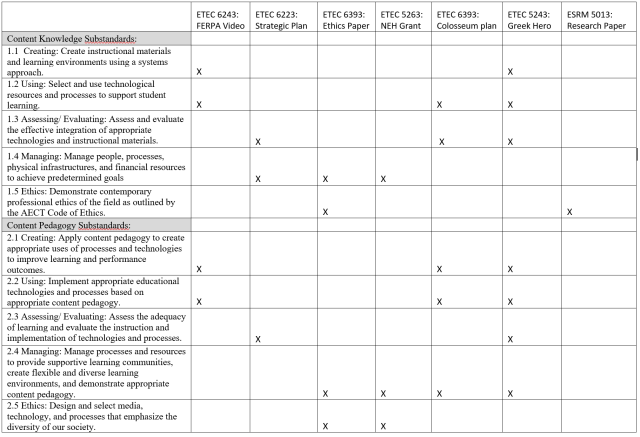
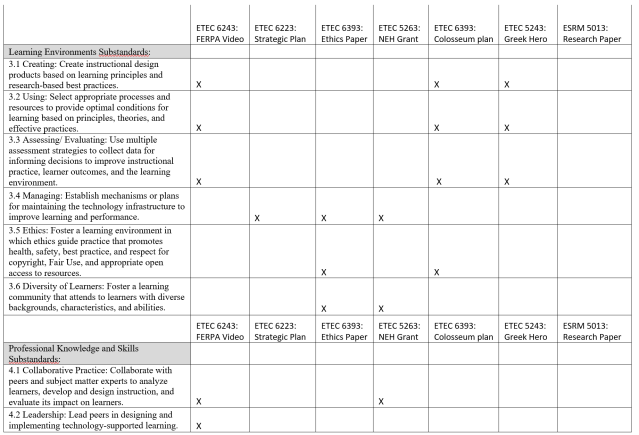
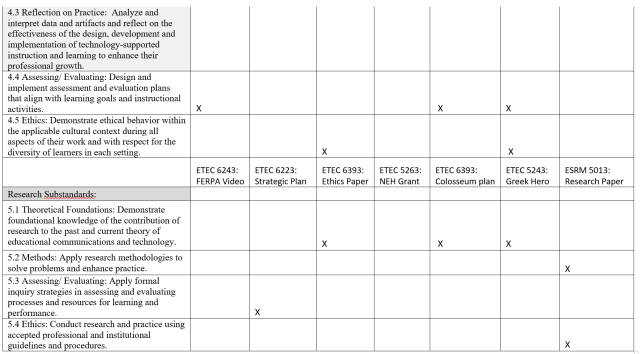
AECT Standard 1: Content Knowledge
1.1: Greek Hero
The creation of a lesson on the Greek hero for my Instructional Design course relied on both the ADDIE approach as well as a personally-created design system in order to produce instructional materials and learning environments appropriate for achieving the identified learning objectives. Due to these multiple systems used, the Greek hero lesson fulfills the requirements of substandard 1.1, which states that “Candidates demonstrate the ability to create instructional materials and learning environments using a variety of systems approaches.”
The production of the overall lesson plan for the Greek hero was the product of a self-designed systems approach to instructional design. This approach was originally rooted primarily in the ADDIE approach, which identifies separate steps for Analysis, Design, Development, Implementation, and Evaluation. Understanding the importance of breaking the creation process down into steps and then logically organizing those steps to produce outputs that lead into the next, I borrowed some of the foundational elements of ADDIE in my own system design. The system design broke down the steps of Analysis in the ADDIE model, following more along the lines of the Dick and Carey Model. In the Identify stage, the instructor is to identify the learning outcomes that are to be achieved. For the Greek hero lesson plan this was (1) knowledge about Greek heroes and Joseph Campbell’s theory on the hero’s journey, (2) the ability to recognize how Greek hero narratives align with Campbell’s theory, and (3) the ability to apply this knowledge to other hero narratives and ultimately the creation of one’s own hero. Next, my system set out to analyze the users and the available technology. This step resulted in the recognition that group work and technology demands should be limited to class time; it also established the maturity level of the material selected—college-level, but introductory knowledge. The next step in my system combined the Design and Development stage of ADDIE. Titled Create, this stage required the simultaneous mapping and production of instructional materials. Such materials included the selection of reading, the creation of multiple handouts to guide students through readings and discussions, the selection of a video introduction to Campbell’s theory, the production of lecture notes on cultural heroes, and the creation of a prompt for the student project on hero design. The final step of my system was Distribution, which roughly aligns to ADDIE’s Implementation step.
While ADDIE’s system ends with evaluation, my system relied on recursive evaluation conducted at every step of the process. This inclusion allowed for some materials to be redesigned and formatted as I evaluated how they addressed the learning goals and appealed to the specific audience. Finally, my system included a reflection stage so that the instructor could note the successes and failures of the lesson for future tinkering and perfecting. Overall, the lesson plan aligned with M.D. Merill’s theory regarding the four phases of problem-solving; first students activated their knowledge in reading, an initial worksheet, and then a video. Next students demonstrated their skills by completing a handout and discussing the information; students then demonstrate their skills through class discussions and finally integrate their knowledge in the creation of their own hero. Through conscientious construction, the Greek hero lesson plan relies on multiples systems in its organization, design, and the creation of instructional materials and environments.
1.2: Greek Hero
As part of the Instructional Design course, I created a Lesson Plan concerning the Greek hero, which was the product of an instructional design process developed as part of the course. The decisions made in the development of this lesson plan demonstrate the successful achievement of substandard 1.2, which states that “candidates demonstrate the ability to select and use technological resources and processes to support student learning and to enhance their pedagogy.”
The selection and application of different educational technologies and teaching materials was a process that was anchored on an analysis of learning goals, actual learners, and available technologies. The lesson plan was designed for an introductory course on Greek mythology at an institution of higher education. The lesson was arranged following constructivist theory, which promotes a scaffold approach to learning. Each unit was created as a building block leading from knowledge acquisition to analysis, interpretation, and application. Based on the learners in this lesson plan and the established learning goals, I was able to select a range of educational resources in order to enhance student achievement. The learners in the scenario are college-age students with diverse bakcgrounds, most of whom live off-campus and might have limited access to technology off-campus. Because of these characteristics, I determined that homework would be limited in its need of technology; instead, students would rely on PDFs and reflection exercises. In class, students would watch the Joseph Campbell video on a Hero’s Journey and participate in extensive group discussion. The video was selected because it was the best available option that appeals to a college-age audience. The group activities were included because it creates a more interactive and engaging learning environment. Additionally, group discussions would benefit from the range of backgrounds and experiences of the students. The diversity of the learners also inspired the final application project in which students created their own hero, combining the aspects of Greek heroes found in the Hero narrative with their own background and experiences. For all of these activities, charts and worksheets were provided in order to guide the students in their analysis, interpretation, and application of Campbell’s theory. The specific technologies chosen were threefold. First, I chose readings that were audience appropriate and easily accessible. I selected the narration of the Greek heroes Theseus, Perseus, and Jason from the Greek author Apollodorus. A textbook summary of these heroes would be too elementary for college-age students, while a more complicated author, such as the poet Ovid would be too advanced for an introductory class. Apollodorus introduces the students to a pimrary source, but in an accessible prose format. Second, I selected an age-approprite video summary of Campbell’s theory. Of the numerous videos online about this theory, many were clearly geared toward high school audiences with their limited vocabulary and use of puppets, while others were too advanced and unengaging, such as the TED talk about the theory. Finally, I designed a lecture and discussion, which would guide students through the identification of other heroes with similar narrative, patterns, but drawn from pop culture and their own backgrounds and experiences.
1.3: Greek Hero
In the creation of a lesson plan for the Instructional Design course, I had to determine the best practices for the selection of educational technologies. In doing so, the final lesson plan fulfills the requirements of substandard 1.3, which states that “Candidates demonstrate the ability to assess and evaluate the effective integration of appropriate technologies and instructional materials.”
In the design and development of course materials, I used various modes of evaluation to produce and select appropriate materials. First, I laid out a series of bullet points about the lives of the Greek heroes the students were to study, but upon evaluation, I realized that such information could be more streamlined and presented in a more organized manner. In the next step, it was necessary to determine the organization of material. Because the students live off campus and have limited access to technology off-campus, it was determined that group work would be limited to in-class activities, as would the video on Joseph Campbell’s hero journey. I selected the readings on Greek heroes, as well as selected and designed charts to guide students through their understanding of Campbell’s theory. Additionally, I viewed and evaluated multiple videos on Campbell’s theory and ultimately selected one whose target audience would be most appropriate for college-age students. The complexity of the information would keep students engaged (as opposed to one using muppets), but the dynamics of the animation would enliven the information (unlike the stagnant TedEx Talk). In addition to these technology choices, I created charts and worksheets that would assist students in their analysis, reflection, and application of Campbell’s theory.
As a final step in this lesson plan, I conducted an analysis of the process used to create the lesson plan and evaluated the different steps in the design process, which I had made. The evaluation consisted of a constant assurance of alignment between learning outcomes and users. Were the readings accessible both in their understandability and in the physical access that students would have to them? Was the video understandable to college students and did it keep them engaged? I was actually teaching a Greek mythology course at this time and had my students review the choice of video. These reviews came back overwhelmingly positive and a number of students noted that they learned more from the video than my previous lecture on the same topic. Finally, I assessed the validity of the personal hero project; did the prompt allow students to recognize the connections between Campbell’s theory, the details of the Greek hero stories, and a student’s own cultural or personal values and experiences?
1.4: Strategic Plan
The development of a strategic plan for Parish Episcopal School required an analysis of stakeholders and processes in order to determine best practices for management of all resources. These decisions as detailed below effectively meet substandard 1.4, which states that “Candidates demonstrate the ability to effectively manage people, processes, physical infrastructures, and financial resources to achieve predetermined goals.”
The process of creating a strategic plan for the use of rubrics in the implementation of competency-based education (ReImagine) at Parish Episcopal School began with identifying the major stakeholders and bringing them all to the table. At the initial meeting, we established our goals for the strategic plan and a timeline for achievement. Over the next four months, I coordinated meetings between administrators and teachers in order to assess our current use of rubrics and future possibilities. In addition to managing the participants, the strategic plan also demanded multiple meetings to determine the needs of our community and the best processes for reaching those goals. I organized small focus group meetings that brought teachers into a dialog with the administration. By facilitating these conversations, we were able to determine mutual goals and best ensure that the ultimate implementation of rubrics would encounter broad approval and minimal resistance, despite the change in procedure. As part of the strategic plan, I also worked with our educational technology specialist in order to determine processes for managing the implementation of rubrics and continued evaluation of their effectiveness.
Additionally, I determined the current capabilities of our available technology and developed plans for training using our available resources. This aspect of management also involved discussing the budget at Parish Episcopal School and determining what funds were available for the purchase of a new learning management system, as well as the funding and time available for training teachers on this new system. By managing the various stakeholders and the tangible and intangible resources, the strategic plan addressed all major aspects of resource management.
1.5: Ethics Paper
The Ethical Framework created for the Issues and Trends course provides guidance and parameters for the integration of technology into the classroom that protects the privacy of the student, empower student learning, and ensures the professionally ethically behavior of the instructor. In all of these, this artifact fulfills substandard 1.5, which requires that “Candidates demonstrate the contemporary professional ethics of the field as defined and developed by the Association for Educational Communications and Technology.”
The Ethical Framework meets the professional ethics standards, as established, by the AECT, in a few key ways. First, the ethical framework establishes the need for iterative consent and transparency on the use of technology in the course. One of the consequences of this principle is that it empowers the individual to be invested in the use of technology; additionally, it allows students to maintain their own personal integrity. It also promotes, from the instructor’s perspective, sound practice in the application of technology. The second principle set out in the ethical framework is the guarantee that all students have equal access to the technology ebing used, and that this access should be provided at the institutional level. Such a principle levels the playing field in terms of socio-economic barriers to technology and it allows for all individuals to have the opportunity to participate. This principle also addresses the sound practice in the selection of equipment.
The third and fourth principles of the framework address concerns over student privacy and the ethical use of student information. Principle three limits instructor interference in online discussion boards, while principle four limits the scope and storage length of student information. Principle four directly addresses the need to protect student privacy, as well as promoting sound practices in the use of technology. Principle three addresses these concerns in addition to creating an environment that encourages free and open discussion from a variety of viewpoints. However, by creating unmonitored but recorded discussion forums, the framework protects students from harmful conditions, discrimination, and harassment. Having the forums recorded allows for review and action on any student complaints. Finally, principle five sets out the parameters for sound use of materials and technology in legal ways that improve student achievement.
AECT Standard 2: Content Pedagogy
2.1: FERPA Video
The creation of a training module for the Help Desk at University of Arkansas, as part of the Advanced Instructional Design course, provided an opportunity to apply pedagogy and use technology in order to improve student learning. This project meets substandard 2.1, which states that “Candidates apply content pedagogy to create appropriate applications of processes and technologies to improve learning and performance outcomes.”
The goal of creating the training module was to instruct student workers at the University of Arkansas Help desk on FERPA (the Federal Educational Right and Privacy Act) and how it directly applies to situations they encounter. In order to determine the content needed, we researched the requirements of FERPA; we found comparable training modules from other schools and institutions, and we interviewed the supervisors at the Help Desk. These processes not only allowed us to determine the specific material needed, but also to identify the best means of delivering that information using technology that would improve student learning through increased engagement. More specifically, our user analysis determined that game-based learning would be the best delivery system for success, given that the users were highly fond of games outside of the learning environment. In interviews with the supervisor, the team identified a number of specific situations that users would experience. Based on these anecdotes, we developed a situational game in which the learner navigates a series of scenarios making decisions based on previously learned information. Each decision received particularized feedback to the user. The goal of this module design was to encourage students to practice knowledge application and usability not just rote memorization. The team determined that developing the training module for Blackboard was the best platform since users would already be familiar with this learning management system. The scenarios were created in Powerpoint and GoAnimate.
The instructional strategies undertaken for this training video were based on the needs analysis of the learners and the available technology. Our learning outcomes were broken down into three categories: Factual information (What is FERPA?), understanding (What does FERPA cover?), and application (How does FERPA apply and to whom?). In order to cover the factual and comprehension levels of learning, we propose expositive methods of direct and indirect instruction. Initially, a form of direct instruction can provide the users with an introduction to FERPA’s definition and what is precisely protected by this law. In the next step—indirect instruction—students would be asked to determine what is protected and what is not, perhaps taking on different roles (students, instructor, parent, etc.). These modules would layout the factual information and establish a base level of comprehension through text box (and/or voiceover) feedback. The final instructional strategy is series of case-based scenarios, which are intended to instruct and sharpen a user’s ability to apply the knowledge acquired in the previous modules.
2.2: FERPA Video
The development of a training module for Help desk employees on FERPA restrictions provided the opportunity to create and employ educational technologies in order to achieve specific learning goals. By providing such an opportunity, the training module meets substandard 2.2, which requires that candidates “implement appropriate educational technologies and processes based on appropriate content pedagogy.”
One of the key decisions that was made in the development of the training module was the appropriate learning conditions give our known users and the content needed to be conveyed. It was only through a detailed user analysis and mastery of the content required that appropriate methods for instruction, as well as optimal technologies, could be determined. The learning goals were determined to be a knowledge of the purpose and regulation of FERPA, the ability to retrieve and understand FERPA regulations, and the ability to apply FERPA regulations to caller inquiries. The learner analysis revealed that the module would be used primarily by 71 part-time student employees. These employees have varied schedules and work at different locations across campus. Because of this, the team determined that the training module must be asynchronous and accessible by mobile device. Because the users were already familiar with Blackboard as a learning platform, the team determined that this would be the best site for hosting the training module. Finally, through interviews with the supervisor of the users, we determined that a game-based design would be the ideal format for engaging the learners and achieving improved performance. The situational, decision-making scenarios that were created were inspired by comparable training programs that were viewed as part of overall research.
Based on the learning objectives of the training—Knowledge, understanding, and application—a four-part module was created. The first part relied on simple interactive powerpoint providing students with factual information about FERPA. The second part included an interactive process in which students had to determine when FERPA might apply and what it might cover. The third part was created with GoAnimate. It consisted of a series of four scenarios in which students were given a specific interaction and must provide a response. The fourth was the culmination of information and positioned students in a branching scenario, built in GoAnimate, that required multiple decisions with feedback and assessment. These last two parts combined the content needed with a game-based pedagogical approach that would best reach the users. All of these parts were pieced together in Articulate and accessed through Blackboard asynchronously.
2.3: Greek Hero
A lesson plan created as part of the Instructional Design course was constructed following an instructional design model that is anchored on recursive evaluation (formative) and an overall reflection (summative). The elements of this design process and its application to the creation of a lesson plan meet the requirements for substandard 2.3, which requires that “Candidates demonstrate an inquiry process that assesses the adequacy of learning and evaluates the instruction and implementation of educational technologies and processes grounded in reflective practice.”
The instructional design process produced for this course and then used in the construction of the lesson plan is comprised of four basic steps—identify, analyze, create, and distribute. However, the process integrates recursive evaluation into the process in order to serve as continuous means of formative evaluation. This decision recognized the importance of regular feedback and the quality control of the educational materials (artifacts) created for student learning. In addition to the consistent presence of evaluation in the design process, the model also includes a summative evaluation referred to as Reflection. This step in the process is intended to encourage instructors to gage the success of their product—how it was integrated into the course, how it addressed learning outcomes, and how it was received by students.
The process of inquiry and evaluation impacted the decision made in the lesson plan throughout the entire development. The first step in the process was to identify the learners, which are students in an introductory Greek mythology course at an institution of higher education. These students primarily live off-campus and their access to technology might be limited when off-campus. The next phase is to analyze the available learning environment and technology as well as the learning objectives. The learning outcomes were determined to be knowledge of famous Greek heroes (Jason, Perseus, and Theseus) and how their narratives relate to Joseph Campbell’s theory on the hero’s journey. In order to achieve these learning goals instructional materials had to be created in addition to identifying available technologies to assist in instruction. In the creation of instructional artifacts, recursive evaluation resulted in the re-organization of worksheets and handouts that would assist the students. Moreover, a number of online videos were evaluated in order to determine the most suitable video introduction to Campbell’s theory. Due to the nature of the learners, homework was limited in both group dynamics and use of technology. The final aspect of the lesson was to offer instructor reflection based on student performance and their overall satisfaction and engagement with the lesson.
2.4: Greek Hero
The creation of a lesson plan about Greek heroes and the Hero’s journey for my course on Instructional Design required me to take on the role of project manager and resource manager in order to design a lesson plan and identify or create the instructional materials that would create a diverse learning community while integrating appropriate material about the topic. In this way, the lesson plan on the Greek Hero meets the requirement laid out in substandard 2.4, which state that “Candidates manage appropriate technological processes and resources to provide supportive learning communities, create flexible and diverse learning environments, and develop and demonstrate appropriate content pedagogy.
In order to design the lesson plan for the Greek hero, I used a systems approach of Analysis, Design, Development, Implementation, and Evaluation. The analysis phase included the determination of learning outcomes. These goals were that student gain a basic knowledge of a few Greek heroes, students learn about Joseph Campbell’s theory of the hero’s journey, and students apply this knowledge to their own experiences in order to create a personal hero narrative. The analysis phase also included a study of the users for this lesson plan, namely college students in an introductory mythology course who primarily commute to campus and have unknown access to technolohgy outside of the classroom. Based on the users and the learning outcomes, I served as a resource manager in the selection and creation of instructrional materials. I chose readings of the Greek heroes from the author Apollodorus. This selection, as opposed to a textbook summary or translated poem about the heroes, provided the right balance of accessible story telling and exposure to primary sources that I sought for a introductory college course. Next, I created a handout that would guide students through the reading of the hero stories so that they focused on narrative elements most relevant to the lesson. The readings and handouts are cost-effective and easy to access for all students. I next selected a video to serve as an introduction to Joseph Campbell’s theory. There are many available instructional videos online; after viewing a number of them, I chose one that seemed to speak to the right audience. Many were too simplified and not engaging (using Muppets) and other were too sophisticated and disenfranchised from the world of mythology (TED Talk). The video selected provided content appropriate for the audience and the lesson.
I created a second handout that encouraged students, as a group, to discuss the overlap between Campbell’s theory and the Greek heroes Jason, Theseus, and Perseus. This handout helps reinforce the goals of the lesson. Next, as a class, the instructor leads students through a discussion of universality versus cultural specificity. Students discuss how heroes have some narrative patterns and similar traits, but are ultimate a product of a specific place or time. Finally, students were tasked with creating their own heroes that were personally and cultural specific to their experiences. This activity was designed to encourage diverse voices and conversations in a supportive and productive way. Students use their personal experiences and cultural values to enliven a discussion of Greek mythology. From this, the class would be able to reflect on the nature of the Greek hero narratives as constructs of ancient Greek culture.
2.5: Ethics Paper
The Ethical Framework created for the Issues and Trends course lays out five principles that are intended to guide the integration of technology into a classroom or other learning environment. By addressing both access and opportunity, this framework addresses the requirement of substandard 2.5, which demands that “candidates design and select media, technology, and processes that emphasize the diversity of our society as a multicultural community.”
A key element to emphasizing diversity and multiculturalism is to ensure that no voice is excluded from the conversation. Principle two of this artifact requires equal access to technology. Equal access is not only hardware and software, but also connectivity questions, such as data speeds and storage. These requirements will level the playing field between lower income and higher income students. Equal access would also potentially help address any achievement gap between these two groups of students. Additionally, such access has the potential to empower students and their voices in discussion. Principle three of the ethical framework help ensure the possibility of empowerment and diverse voice. This principle establishes an unmonitored discussion forum for classroom conversations. The unmonitored nature of the forums is to encourage students to feel free to speak their minds and have open and honest conversations. However, in order to prevent these spaces being ruined through cyber bullying, harassment, or any discriminatory language, all sessions will be recorded. This decision is a protective one that is intended to provide safety and legitimization to students who feel harassed or discriminated against. Now a recording will be made, which is able to support any complaints brought.
AECT Standard 3: Learning Environments
3.1: Greek Hero
The design and development of a lesson on Greek heroes for my Instructional Design course required me to create different learning products that were guided by constructivist principles and user-centered design. This lesson plan addresses substandard 3.1, which dictates that “candidates create instructional design products based on learning principles and research-based best practices.”
The Greek hero lesson plan takes place over two class periods. As part of the learner analysis, I took into account that the learners were college students in an introducotyr mythology course; additionally, these students had varied backgrounds and experiences. In order to account for their different experiences, the culminated in an assessment activity where students would apply the knowledge learned from previous discussions to their own background and knowledge. More specifically, students would first learn about a few Greek heroes and then discuss Joseph Campbell’s theory about the universality of the hero’s journey. Students ultimately will take the broad elements of Campbell’s theory, the specific instances of the Greek heroes, and their own experiences to create a hero that represents their values and culture. Not only is this instructional plan designed and developed in such a way that accounts for the different interpretations of individual learners, but it also relies on student voice in the final project. The activity and the parameters are established by the instructor, but it is the student who must bring their own background into the course work in order to successfully complete the assignment. Having the students apply their knowledge and produce their own product, in this instance a hero, has been demonstrated to more effectively engage students in learning and result in a longer retention of knowledge. The lesson plan follows these best practices, and also incorporates guided group discussion to help motivate learners.
3.2: Colosseum Plan
As part of the Issues and Trends in Instructional Design course, I created a lesson plan for an introduction to the Colosseum and Roman spectacle through the use of virtual reality and game-design. The decisions made in the creation of this lesson plan were based on careful consideration of possible methods and materials that would provide an ideal learning environment based on constructivist principles and user-centered design. In these ways, the Colosseum lesson plan fulfills the requirements of substandard 3.2: “Candidates make professionally sound decisions in selecting appropriate processes and resources to provide optimal conditions for learning based on principles, theories, and effective practices.”
In the design and development of the lesson plan, a number of various processes and resources were considered. I chose a constructive perspective as the process in which to structure the lesson plan and determined that integrating user-centered design would result in the maximum student engagement and learning retention. The use of a virtual reality tour would allow for the students to experience knowledge acquisition and application in a close-to authentic environment; the student-prepared questions for the guided tour and the scavenger hunt encourage both individual responsibility and personal initiative. Finally, the summative assessment—a collaboratively-designed spectacle—allows for a dynamic production. Additionally, the final activity is designed as problem-based learning since the students are given an emperor and tasked with how he would have sponsored a Roman spectacle. Students have to take into account the personality of the emperor, the historical context, the economic circumstances, and general cultural preferences of entertainment in order to propose a solution.
The choice of virtual reality is the appropriate resource for a number of reasons, given the learning objectives of the lesson plan. While initial costs might be burdensome, the decision ultimately contributes tot the sustainability of the Colosseum itself. Not only is the site regularly damaged by the millions of visitors every year, the actual cost of visiting is prohibitive to many students in the United Sates (and outside of Europe). Virtual reality brings the monument to the students and saves the actual remains from foot traffic and vandalism. Moreover, virtual reality offers one of the best opportunities for students to experience the Colosseum in its most authentic context—covered in marble, filled with spectators; things that are difficult to envision when walking the ruins or looking a photos. Furthermore, the lesson plan assumes that all students and teachers will have had training on the media and its proper use. Finally, as virtual reality improves it can offer a fully sensory experience to learners, adding in the noise of the crowd and the smell of thousands of spectators (pre-deodorant), food vendors and perfume seller, and of course bloody combat. Perhaps not all desirable smells, but certainly authentic. Overall, the use of virtual reality to guide students through the Colosseum on a tour of the ruins and a scavenger hunt of a reconstruction provide optimal learning conditions. These experiences are then built upon with a collaborative activity of game-design, having students apply their knowledge of history and culture to the space, which they just explored.
3.3: Colosseum Plan
In the lesson plan for an introduction to the Colosseum and Roman spectacles, students undergo a series of subjective assessments that allow the instructor to gage both student achievement and the efficacy of the instruction and environment. By combining multiple assessments, the Colosseum lesson plan meets the requirement of substandard 3.3, which states that “Candidates use multiple assessment strategies to collect data for informing decisions to improve instructional practice, learning outcomes, and the learning environment.”
Following current preferences targeting deeper learning through active use as opposed to surface learning, the Colosseum lesson plan minimizes the assessment of retained information. Instead, the majority of assessments are designed at the level of understanding and problem-solving. Additionally, because the lesson plan is guided by a constructivist perspective, students are given great ownership in their pathway to navigating and achieving the learning outcomes. In the first step of lesson, students watch a video about the engineering of the Colosseum as homework. They are tasked with identifying three interesting facts about the Colosseum and a list of questions. In class, students enter a virtual reality world in which they are guided through the ruins of the Colosseum by an expert. At this point students ask their questions and offer their points of interest. In this way, the students direct their own tour and the guide serves as a resource for feedback. The instructor assesses based on student participation, but this is also complemented by a BINGO game. Each student is given a BINGO card with different terms associated with the Colosseum. As they tackle each of these terms, students mark off their cards. This gamification of learning further incentivizes the students (plus, the first to BINGO receives extra credit)!
In the next stage, students are partnered with a classmate to complete a scavenger hunt. Each team is place in a different space of the virtually reconstructed Colosseum. They explore the space and receive information about its use. Once they are done exploring, they take a short quiz that reviews their knowledge acquisition. If correct, they move onto the next room. This self-directed tour, with regular feedback, allows the students to take ownership of their learning path. In the final room, they receive a prompt for the assessment in the next class. As homework, students read about the way different emperors used Roman spectacle as propaganda. In the next class, students are divided into groups. Their prompt asks them to assume the role of a specific Roman emperor and then to design a program of spectacles based on the personality of the emperor, the historical circumstances, cultural preferences, and other important factors. They must then present their choices to the class. This final assessment deals heavily with applied knowledge. Students are asked to relate their previous knowledge to a new subject and space; they must examine their design critically and reflect on their decisions as they defend their choices to the class. Moreover, the problem-based learning assessment creates a collaborative community in which students engage in discussion thereby developing deeper understanding of the material.
3.4: Strategic Plan
Many aspects of the strategic plan for Parish Episcopal School required developing processes for the implementing, managing, and assessing the proposed use of rubrics and their impact on student learning. The methods created, as detailed below, meet substandard 3.4 by establishing “mechanisms for maintaining the technology infrastructure to improve learning and performance.”
The overall goal of the strategic plan was to identify not only the best practices for the use of rubrics in competency-based education at Parish Episcopal School, but also to determine the best technology available for that use. The strategic plan ultimately identified the needs of the Parish community and laid out the criteria that were necessary in a learning management system to meet those needs. While a specific learning management system was not identified yet during the course of the strategic plan, the produced analysis resulted in our administrators starting conversations with new learning management companies as well as working with a previous contractor to discuss the possibilities of developing our own, personalized system.
The strategic plan also included a timeline for the regular evaluation of this learning management to determine its effectiveness. The timeline laid out a two-year plan for gradual implementation. The first round would consist of a trial run during our spring prototype in 2018. Once this was completed a series of surveys and evaluation interviews would occur. Next would be broader faculty development over the summer. A number of faculty would be targeted for course-based implementation in the fall of 2018. This process would continue with another round of evaluation, faculty development and expansion into the spring of 2019. A final round of prototyped evaluation would occur at the end of the spring semester with campus-wide training conducted in the summer. All courses would be expected to implement the prescribed rubric plan by Fall of 2019. The evaluations included both teacher perceptions as well as student performance data. By regularly evaluating these data, Parish Episcopal School will be able to make necessary adjustments to the use of rubrics in order to ensure high student performance. The technology infrastructure would be managed by Paul Tidmore, as well as our technology information staff. Additional funding would be set aside to account for maintenance of the new learning management software and teacher training.
3.5: Ethics Paper
The Ethical Framework created for the course on Issues and Trends in Instructional Design addresses many of the current concerns of Educational Technology specialists regarding the best practices of technology in a modern learning environment. By addressing concepts of use, access, and safety, the Ethical Framework addresses the requirements laid out in substandard 3.5, which states that “Candidates foster a learning environment in which ethics guide practice that promotes health, safety, and best practice and respect for copyright, Fair Use, and appropriate open access resources.”
The Ethical Framework lays out five guiding principles for the integration of educational technologies into a learning environment. Principle One and Four best address a student’s safety within a learning environment. Principle One requires that instructors provide detailed information on the use of technology in the course and how it relates to the assessment of student performance. Students must provide repeated consent to this use. Such a provision protects students from a misuse of technology in their assessment; it requires the instructor to articulate the precise purpose of educational technology, and it encourages students to have a vested interest in the assignment. Principle Four protects the privacy of students from the collection and exploitation of data. This principle demands that the collection of student information be limited in scope and in permanence. Such a principle protects the privacy of students and allow students to feel more secure in their participation in the course.
Principles Two and Three look out for the health of the student, both physical and mental. Principle Two requires that all students have equal access to the technology. From a psychological viewpoint, such a provision levels the socio-economic playing field between wealthier and lower-income students. From a physical health perspective, an instructor would have to take into the account the actual burden of the technology for all students, including the weight of carrying around any required hardware, the detriment to eyesight, and even the repetitive typing required from multiple logins and other assignments. Principle Three focuses primarily on the mental health of students, but designing a learning environment that is protective of student voices, but discouraging (and prohibitive) of abuse and harassment. Finally, Principle Five demands that all instructors and students be trained in the proper and legal use of technology, instructional materials, and open access resources. Through professional development, instructors will become better informed of the benefits and effective use of educational technologies while respecting copyright and Fair Use laws.
3.6: NEH Grant
The Public Humanities Grant submitted to the National Endowment for the Humanities is grounded on the belief that bringing people together from different cultures and communities is the best way to foster growth, understanding, and global citizenship. The proposed conference and subsequent video discussions, detailed below, meet the requirements of substandard 3.6 by demonstrating the ability to “Foster a learning community that attends to learners with diverse backgrounds, characteristics, and abilities.”
The grant to the NEH proposed a conference in San Antonio in which the focus would be on how cultural monuments were affected by the threats of the 21st century, particularly tourism, urbanization, and conflict. The proposed conference would be the launching point for a series of web videos to be created discussing the same issues as they were experienced across the globe in different cities, countries, and communities. These videos were intended to be educational and designed for a high school or college classroom as a means of generating discussion and debate about the value of cultural heritage in an ever globalized and modernized world. The initial conference would bring together scholars from two distinct communities—those working on the native American and early American history of central Texas and those working on the archaeological sites and historical monuments of Turkey. While very different in time and geography, both of these communities face similar issues concerning tourism and urbanization. Both San Antonio and Istanbul (as well as other cities in Turkey) continue to grow, but a balance must be met between development and preservation. In particular, what should be preserved and why? One of the main conversations of the conference and subsequent videos would be to address the importance of cultural heritage and how communities can use preservation as a means of highlighting their diversity and shared history. The conference as well as the subsequent videos, particularly if circulated in classrooms, would allow for and encourage opportunities for sharing diverse points of views and experiences.
AECT Standard 4: Professional Knowledge and Skills
4.1: FERPA Video
The creation of a FERPA training module for student employees of the University of Arkansas Help desk required extensive collaboration with designers and stakeholders. The entire process and the resulting training module demonstrate the successful achievement of substandard 4.1, which requires that “candidates collaborate with their peers and subject matter experts to analyze learners, develop, and design instruction, and evaluate its impact on learners.”
Collaboration began between myself and the other three students of the Advanced Instructional Design course. We had these early communications with our instructor, Dr. Cheryl Murphy. After initial course meetings, we began communications with our clients, Shelly Walters and Travis Lynch from IT at University of Arkansas. We held these meetings through Blackboard Collaborate as needed, while meetings with the team and Dr. Murphy occurred through Collaborate at least once a week. Ms. Walters and Mr. Lynch served as subject matter experts for FERPA and the students who would be our learners. Through conversations with Dr. Murphy and our experts, the team was able to produce an analysis of the learners and articulate our learning outcomes. As a team, we worked together using multiple shared platforms, including Trello for project management, Google Drive for shared materials, and Collaborate for communication (in addition to email and phone communication). In these collaborative spaces, we designed our four-part training module, divided the tasks, and developed the lessons. Finally, we also determined best practices for evaluation of the training module.
4.2: FERPA Video
In the production of the FERPA training module for the Advanced Instructional Design course, I was able to take a leadership role in guiding the design and development of lessons. Through the creation of the learning module, the substandard 4.2 was met, which states that “Candidates lead their peers in designing and implementing technology-supported learning.”
The FERPA training module was a collaborative, team effort in which the students of the Advanced Instructional Design course designed and developed a four-part lesson with the goal of instructing part-time IT workers at the University of Arkansas on how FERPA regulations impact their work and interactions with students and teachers. Although this ultimately was a collaborative effort, I was able to take the leading role on a few key elements. In addition to helping divide responsibilities among the students, I was tasked with conducting the user analysis, as well as composing the scripts for the single scenario and branching simulations. The learner analysis was conducted primarily through interviews with out subject matter experts, Shelly Walters and Travis Lynch. This learner analysis revealed that there would be around 71 users, who were part-time employees at the University of Arkansas, working in the IT department, while also taking courses. I also learned from the subject matter experts that these users were motivated greatly by gamification. Furthermore, it became apparent that given their irregular schedules and their varied work environments, creating an asynchronous course that could be accessed on a laptop or even mobile device would be necessary for student achievement.
Based on this learner analysis, I helped guide the team in identifying learning outcomes and then designing and developing the course content and organization. In conversations with our subject matter experts, I helped establish that our learning outcomes were threefold. First, students should obtain a rudimentary understanding of FERPA, that is factual information about what specifically FERPA is. Second, students should be able to identify what FERPA covers in regards to the student records that Help Desk employees might encounter. Third, users should be able to apply this knowledge of FERPA to real situations that they will experience. Given these learning outcomes, I researched and identified the most effective instructional strategies for achieving the goals, including direct and indirect instruction and simulated practice. With these instructional strategies, I designed tiered lessons, which built one upon the other, moving the user from basic knowledge acquisition to interpretation and application.
4.3: Reflection on practice.
“Candidates analyze and interpret data and artifacts and reflect on the effectiveness of the design, development and implementation of technology-supported instruction and learning to enhance their professional growth.”
4.4: Colosseum Plan
The lesson plan for the Roman Colosseum includes a number of assessments at the different stages to ensure that students are achieving the learning outcomes and that the activities are effective. Because of this, the Roman Colosseum lesson plan meets the requirements of substandard 4.4, which asks that “Candidates design and implement assessment and evaluation plans that align with learning goals and instructional activities.”
There are four learning goals in the Roman Colosseum lesson plan. First, students learn the basic history and construction of the Colosseum, as well as the architectural vocabulary that accompanies it. Second, students gain an appreciation for the use of space and how space can signify function or control action. Fourth, students recognize the range of spectacles in Roman entertainment and why there might be preferences for certain kinds at certain time. Fourth, student are able to understand how spectacle and space can be used for propaganda, reflecting identity, and reinforcing cultural values. In order to achieve the first goal, students are tasked with watching a video on the Colosseum. They create questions and point of interest from this video. In class on the next day, they receive a guided virtual tour through the Colosseum in which they ask their questions and discuss their points of interest with the tour guide/instructor. This subjective assessment of participation si the first; it is complemented by handing out BINGO cards with the various terms associated with the Colosseum. As the tour guide discusses the terms, students check them off. The participation and BINGO assess the first learning outcome and introduce students to the second.
In the second stage of the lesson, students partner up to complete a scavenger hunt. In this exercise, each team is placed in a different space of the reconstructed Colosseum. Students interact in their spaces, learning about the different features. In order to move on, they must complete a short quiz about the function of the space. This assessment addresses the second learning objective. Once they have moved through all of the spaces, the students receive an assignment of a specific emperor. For homework, they read a chapter about Roman spectacle and how different emperors used spectacles for their own purposes. In class on the next day, students work in groups to design a series of spectacles that their assigned emperor would sponsor. They must use game-design software to recreate the spectacle and then put together a presentation for the class on their spectacles. This group activity serves as the summative assessment, bringing all of the learning goals together and particularly highlighting the third and fourth goals, while applying their knowledge of the first and second goals.
4.5: Greek Hero
While all of my instructional design lessons and projects have taken into account cultural context and respect for diversity, the lesson plan for Greek mythology, created as part of the Instructional Design course, relies on the diversity of users to successfully complete this assignment. By taking into account cultural context and learner diversity, this lesson plan meets the requirements laid out in substandard 4.5, which states that “Candidates demonstrate ethical behavior with the applicable cultural context during all aspects of their work and with respect for the diversity of learners in each setting.”
The lesson plan, which focuses on hero narratives in Greek mythology, was designed in such a way to account for a wide range of users, particularly in terms of accessibility. Because the learners in this lesson plan are students at a commuter college, the use of technology and group work outside of the classroom was kept to a minimum. Because most of the students live off campus, all group work was limited to the actual classroom. Additionally, because many of the students might have limited access to technology, their homework was limited to printed PDFs of the stories and worksheets. The required online video was shown during class to ensure that all students were able to view it. More than these questions of accessibility, however, the lesson plan intentionally encourages students of diverse backgrounds to integrate their own experiences and voices into the class discussion and their final assignment. The lesson begins with the stories of the Greek heroes Jason, Theseus, and Perseus. Students read these narratives and using a worksheet identify the basic narrative features and work, in groups, on recognizing patters. Next, they watch a video about Joseph Campbell’s theory on the hero’s journey, and as a group, they analyze how the Greek stories align with Campbell’s theory. In the next steps, students bring in their own backgrounds. First, students are encouraged to identify stories they are familiar with that follow Campbell’s theory. Next, the instructor articulates that, while the narrative structure might have universal features, the details are always a product of a specific culture and reflective of that culture’s values. Next, each student is tasked with creating their own hero and hero narrative based on their cultural experiences and background. The creation of such heroes values the diverse backgrounds of the students.
AECT Standard 5: Research
5.1: Colosseum Plan
In the course on Issues and Trends in Instructional Design, I created a lesson plan for an introduction to the Roman Colosseum and Roman spectacle that involved virtual reality, a scavenger hunt, and a collaboratively designed project. These decisions were based on research into previous preferences in educational technology, current theories of instruction and cognition, and future possibilities of technology. In all of these ways, the Colosseum lesson plan demonstrates mastery of substandard 5.1, which requires that “Candidates demonstrate foundational knowledge of the contribution of research to the past and current theory of educational communication and technology.”
In the development of the Colosseum lesson plan, research was conducted on previous and current best practices in education. This research demonstrated that previous approaches to education controlled the learning environment and the learning process; in this approach the learner was the recipient of knowledge and that knowledge would primarily fall under the category of shallow learning. Following current theories in education and instruction, the Colosseum lessons shifts away from the control of learning to the facilitation of learning. In this paradigm, the learner has a vested interest in constructing the learning process and gaining deeper knowledge in authentic learning environments. For example, in the Colosseum lesson plan, students first assignment is to create their own questions based on their interests and confusion for the tour guide the next day. Additionally, students then are partnered up and take part in a scavenger hunt through a reconstructed Colosseum. While the parameters of the scavenger hunt are laid out, students progress at their pace and they determine the order of the rooms and spaces they explore. In this way, the scavenger hunt activity is designed from a constructivist perspective, by which students have ownership of their learning pathway and use their personal knowledge and experience to guide themselves through the activity.
This activity as well as the final project were determined based on research which claims that the gamification of learning activities offers a better opportunity for student engagement and the longer retention of knowledge. The final project requires the students work together to create a series of spectacles sponsored by a specific Roman emperor; they use game-design software in order to create these spectacles and then present their choices to the class. In this project, students work collaboratively, apply their knowledge and make connections, and take ownership of their decisions in the presentation. Finally, the overall lesson plan was organized around research into future educational technologies that are growing in popularity and accessibility. The use of virtual reality headsets and game-design software allow students to have an immersive and authentic learning experience.
5.2: Research Paper
The Research Paper written as part of the Research Methodologies course relied on properly acquired data in order to establish a hypothesis, test the data, and produce a conclusion. By bringing together all of these steps, this artifact meets the substandard 5.2, which requires that a candidate, “apply research methodologies to solve problems and enhance practice.”
This artifact relies on survey data in order to determine if one’s perceived ability to stay motivated through challenges and failures has any relationship to education level achieved. The artifact produces all of the standard aspects of a sound research paper in order to address this question. The artifact includes a literature review of current journal articles and research studies addressing the same question or those broadly related to issues of student motivation. The data was gathered from voluntary anonymous surveys which used a Likert scale to rate student motivational tendencies. The survey results were categorized and valued. Once scores for the relevant questions were averaged, the artifact shows the result of a chi-square test comparing the student perception of motivation to their stated level of education. The hypothesis proposed that there would be a direct correlation between motivation and level of education. However, after performing the test, the results demonstrated that any correlation was not statistically significant, and therefore, the hypothesis had to be rejected. Despite this failure to provide a proven benefit of increased motivation, the study does support the myriad of previous studies that point to the multi-faceted variables that go into impacting an individual’s motivation to learn. Ethnicity, culture, age, gender, subject matter, and so much more can impact motivation. Moreover, the research conducted addresses a question on the benefit of student-motivation. What is the end goal of keeping students motivated in courses and how should that desire align with a student’s educational achievement level.
5.3: Strategic Plan
The creation of the strategic plan for the use of rubrics in competency-based education at Parish Episcopal School involved a variety of processes in the pursuit of determining the needs and proposing solutions. The overall approach taken resulted in the fulfillment of substandard 5.3, which states that candidates demonstrate the ability to “apply formal inquiry strategies in assessing and evaluating processes and resources for learning and performance.”
The strategic plan gathered both quantitative and qualitative data in order to propose a best solution. Quantitative data was gathered primarily through a Google survey, which I created and circulated to all teachers in the Middle and Upper schools (grades 5-12). This survey asked teachers to comment upon a range of issues regarding their current use of rubrics. Some of these questions included the frequency with which they used rubrics, the types of assignments they rubrics for, the point scale used on their rubrics, the software used to create rubrics, the means of storing and sharing rubrics, and how they integrate rubrics into our current online grade book. Additionally, it asked teachers to volunteer to speak one-on-one in more detail about this topic. The data collected from the survey allowed me to identify the need for flexibility both in the types of assignments for which rubrics are used and for the point scale used on the rubrics. While the administration had initially wanted to switch from 0-100 grade scale to a 1-4 rubric scale, the data from the survey indicated that this drastic switch would be met with significant push back among the faculty. Instead, we determined that a transition to a 60-100 scale, with minimal breaking points between the 10s would be ideal. In other words, students would get a 60, 65, 70, 75, 80, etc. as opposed to a 67 or 83. It was determined that this compromise would allow the administration to adopt a full 1-4 scale in the next few years more seamlessly than if done immediately.
Qualitative data was gathered through interviews and small group discussions with the various stakeholders. Teachers were particularly helpful in laying out their current use of rubrics and how they would like to see rubrics used in their future classrooms. It became abundantly clear from these conversations that the future learning management system needed a better means of storing and organizing the rubrics, as well as a more intuitive way of applying the rubric to specific assignments in the online gradebook, while still allowing the teacher to provide comments and qualitative feedback. In addition to this needs analysis, the strategic plan also involved inquiry into how rubrics are used at sister schools in the Dallas area and across the United States. A short email questionnaire was sent out to six Dallas schools and web research was conducted on a school in New Hampshire and one in Oregon. This data provided information on the range of practices used, particularly with regard to non-academic assessments, such as punctuality and preparedness. All of these approaches to assessment and analysis resulted in a strategic plan that was designed to realize institutional change in the use of rubrics at Parish Episcopal School as it transitions to competency-based education.
5.4: Research Paper
The Research Paper written for the Research Methodologies course relied on data gathered from survey participants. The process for gaining and using this data demonstrate that the candidate understand and fulfills the substandard 5.4, which demands that one conducts “research and practice using accepted professional and institutional guidelines and procedures.”
The basis for the research paper was a survey about student motivations, which also included substantial demographic information, such as age, gender, ethnicity, and education level. These surveys were completed voluntarily and were anonymous submissions. The survey was developed by the students in Research Methods in Education (ESRM 5013) at the University of Arkansas, Fayetteville in 2003. Data was gathered through convenience sampling; students requested responses from their family, friends, other students, and acquaintances. Following professional guidelines, as well as the institutional standards set out by the University of Arkansas, the entire project received Institutional Review Board (IRB) approval for conducting research on human subjects. This approval was received before any data was collected. The approval for conducting research from the Institutional Review Board assures that the study and the researcher do not use humans (or animals) in any procedure or way that would be physically harmful or invasive. Ultimately, this approval is meant to guarantee the protection of human (and animal) participants in a study. Because the research conducted for this paper involved a voluntary and anonymous survey by human participants it was deemed as not harmful or physically invasive.
 Educational Technology Portfolio